
Supreme Court Decision Enrages Trump, Making Economic Outlook Increasingly Uncertain
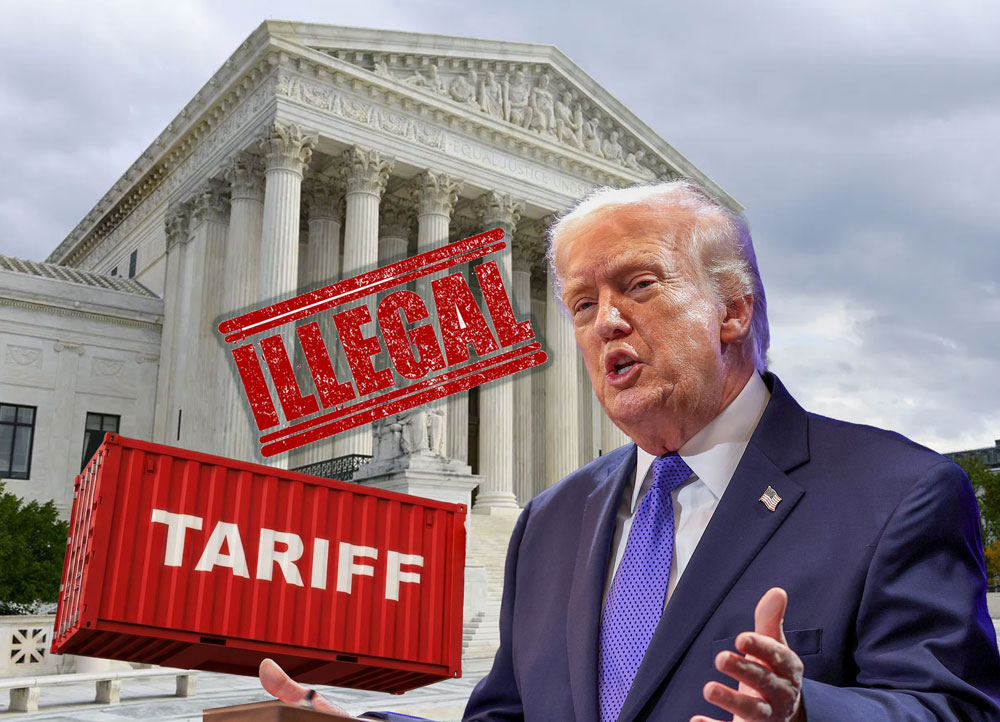
On February 20, 2026, the trade world was rocked by a 6-3 Supreme Court ruling in Learning Resources, Inc. v. Trump. The Court held that the International Emergency Economic Powers Act (IEEPA) does not authorize the President to impose broad, multi-country tariffs without Congressional approval.
While this effectively struck down the “Reciprocal” and “Fentanyl” tariffs of 2025, the administration responded within hours. President Trump has now invoked Section 122 of the Trade Act of 1974, announcing a new 15% global surcharge effective Tuesday, February 24, 2026.
2026 Economic Forecast
The pivot from the invalidated IEEPA rates to the new Section 122 surcharge has created a “K-shaped” outlook for 2026:
- Inflation Sticky at 3%: While the invalidation of the highest 2025 rates provides relief, the new 15% baseline ensures that consumer price inflation will not return to the 2% target this year.
- The Refund Stimulus: U.S. Customs is bracing for roughly $175 billion in refund claims from businesses that paid the now-illegal 2025 tariffs. This “accidental stimulus” may temporarily boost GDP growth in Q3 2026.
- 150-Day Clock: Section 122 authority expires in 150 days. Expect a massive lobbying battle in Congress by July 2026 as the administration seeks to make these rates permanent.
Small Business Impact: Focus on the Dry Cleaning Industry
Small businesses, which lack the legal teams to navigate complex exclusions, are facing a “Volatility Tax.” The dry cleaning industry is particularly vulnerable to the indirect effects of these tariffs.
1. The Hanger and Poly Bag Crisis
Because Section 232 (Steel/Aluminum) tariffs were not struck down by the Court, the 25%–50% duties on imported steel wire remain.
- Hangers: Costs remain up to 40% higher than 2024 levels.
- Packaging: Polyethylene bags (plastic covers) are subject to the new 15% Section 122 surcharge, as most are imported from Southeast Asia.
2. Solvent and Chemical Surcharge
Professional cleaning solvents (PERC and eco-friendly alternatives) rely on chemical precursors often imported from China or the EU. These are now subject to the 15% surcharge, forcing local owners to either eat the cost or raise “per-garment” prices, risking a loss of foot traffic.
3. Equipment Maintenance
Replacement parts for Italian or German-made pressing machines and boilers are now 15% more expensive due to the surcharge, increasing the “cost of failure” for local mom-and-pop shops.
Global Comparison: Current Tariff Landscape
Following the SCOTUS ruling and the Section 122 pivot, here is the state of play for major U.S. trading partners:
| Country | Status of 2025 Duties | Current Rate (as of Feb 24, 2026) | Key Industry Impact |
| South Korea | Struck Down (IEEPA) | 15% Global Surcharge | A major win for Korean tech, but 25% Auto tariffs remain under Section 232. |
| China | Struck Down (IEEPA) | 15% Surcharge + Sec. 301 | Total effective rates remain high (30%+); Section 301 was not affected by the ruling. |
| Canada | Struck Down (IEEPA) | 0% – 15% | USMCA-compliant goods are exempt; non-compliant goods hit by 15% surcharge. |
| Mexico | Struck Down (IEEPA) | 0% – 15% | Similar to Canada; strict “Rules of Origin” now dictate who pays the 15% tax. |
| European Union | Struck Down (IEEPA) | 15% Global Surcharge | Applies to luxury goods and machinery; Steel/Aluminum remains at 50% (Sec. 232). |
Action Steps for Business Owners
- Audit Your 7501 Forms: Check all imports from Feb 2025 to Feb 2026. You may be entitled to a full refund of the “Reciprocal” or “Fentanyl” portions of your duties.
- Review Supplier Contracts: Many suppliers added “Tariff Surcharges” in 2025. Ensure these are adjusted to reflect the new 15% rate rather than the previous higher levels.
- Inventory Hedge: Consider stocking up on essential consumables (hangers, solvents) before the 15% Section 122 surcharge fully filters through to distributor pricing in March.
