If you ask ten people who practice wet cleaning how they do it, you’ll get ten different answers. That alone suggests how much experimentation and research has gone into it—but from the perspective of traditional dry cleaners, it can also be the number one reason for unease.
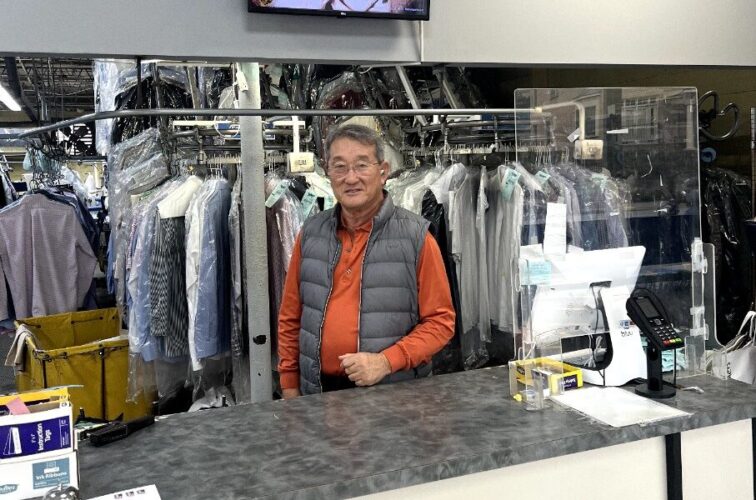
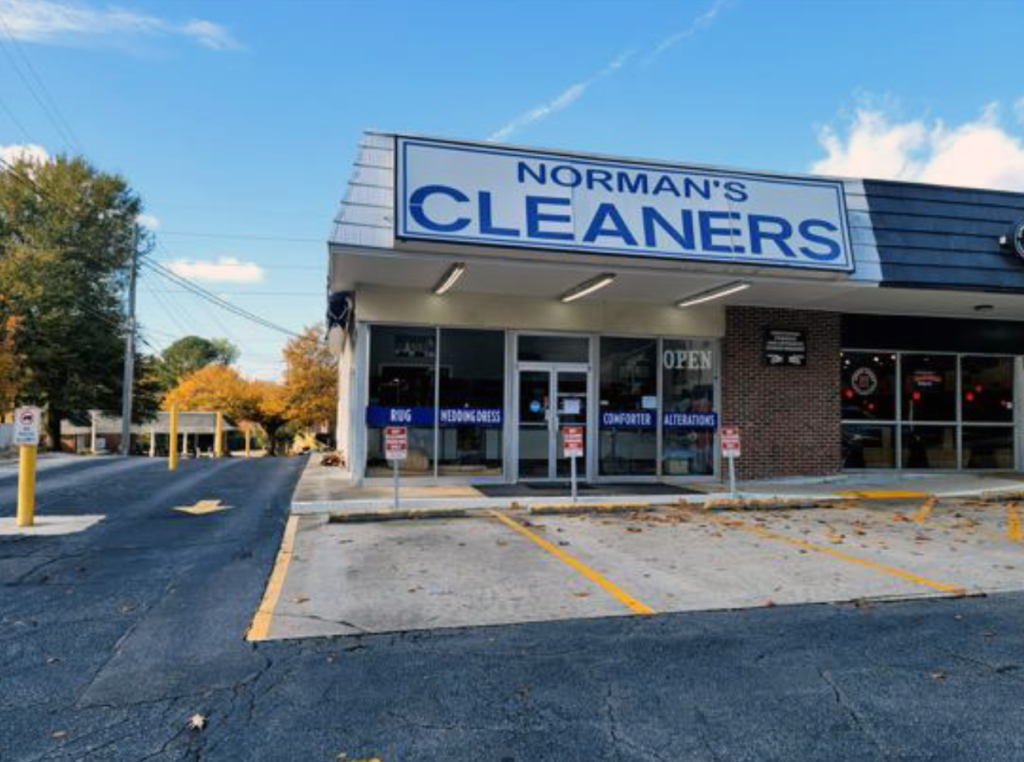
Ja-uk Ko, owner of Norman’s Cleaners in Atlanta, is a so-called wet cleaning expert with more than ten years of hands-on experience. And now, he says, “A new standard for wet cleaning has been established.” Let’s hear his story.
Started Wet Cleaning Because of Solvent Odor
Mr. Ko came to Atlanta in 1982 and ran several businesses, including grocery stores. After many years serving mostly black customers, he says he began to want a business catering to white customers as well.
“At the time, there weren’t many Korean-owned dry cleaners in Atlanta. We washed with small transfer machines and pressed everything by hand. Looking back, it sounds unbelievable, but earning $4,000 to $5,000 a month was enough to make a living back then.”
In 1990, Mr. Ko acquired a dry cleaner called European Cleaners. It had a 25-pound dry cleaning machine, and everything was still hand-pressed.
Like most operators, he started with perc and later switched to hydrocarbon solvent when concerns about carcinogenic risks emerged.
“I was using hydrocarbon in a non-cooking machine, and one day I noticed an odor. This was something I had never experienced with perc. I tried everything imaginable, but nothing solved the problem. Eventually, I had no choice but to start wet cleaning.” That was ten years ago.
“At first, it was extremely difficult. Anyone who started wet cleaning in the early days probably tried all sorts of things. That’s why wet cleaners all do it differently and tend to have very strong personal methods.”
Nine years ago, once wet cleaning had stabilized, Mr. Ko removed his dry cleaning machine altogether. He firmly believes that as long as you keep a dry cleaning machine, wet cleaning can never truly evolve.
“I Had No Idea AquaMax Was This Good”
Until recently, Mr. Ko had been wet cleaning with three 55-pound UniMac washers. They worked well enough, but there was one lingering frustration.
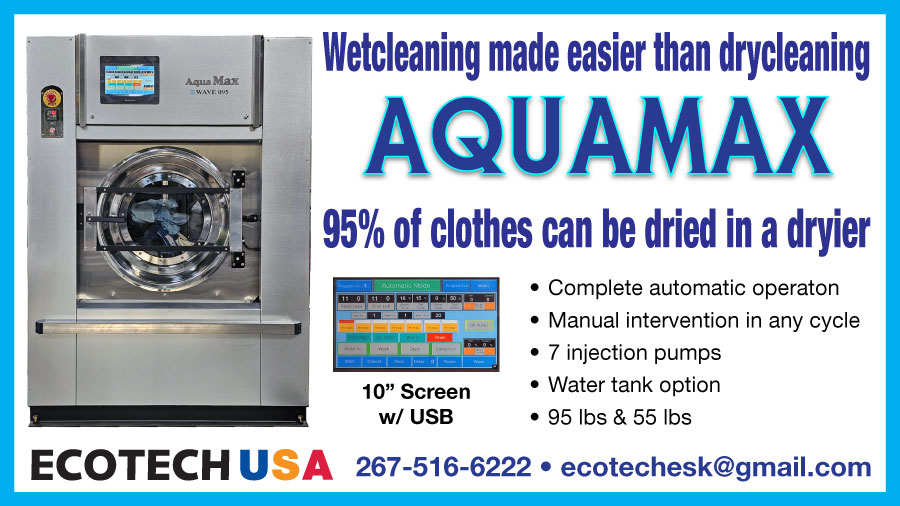
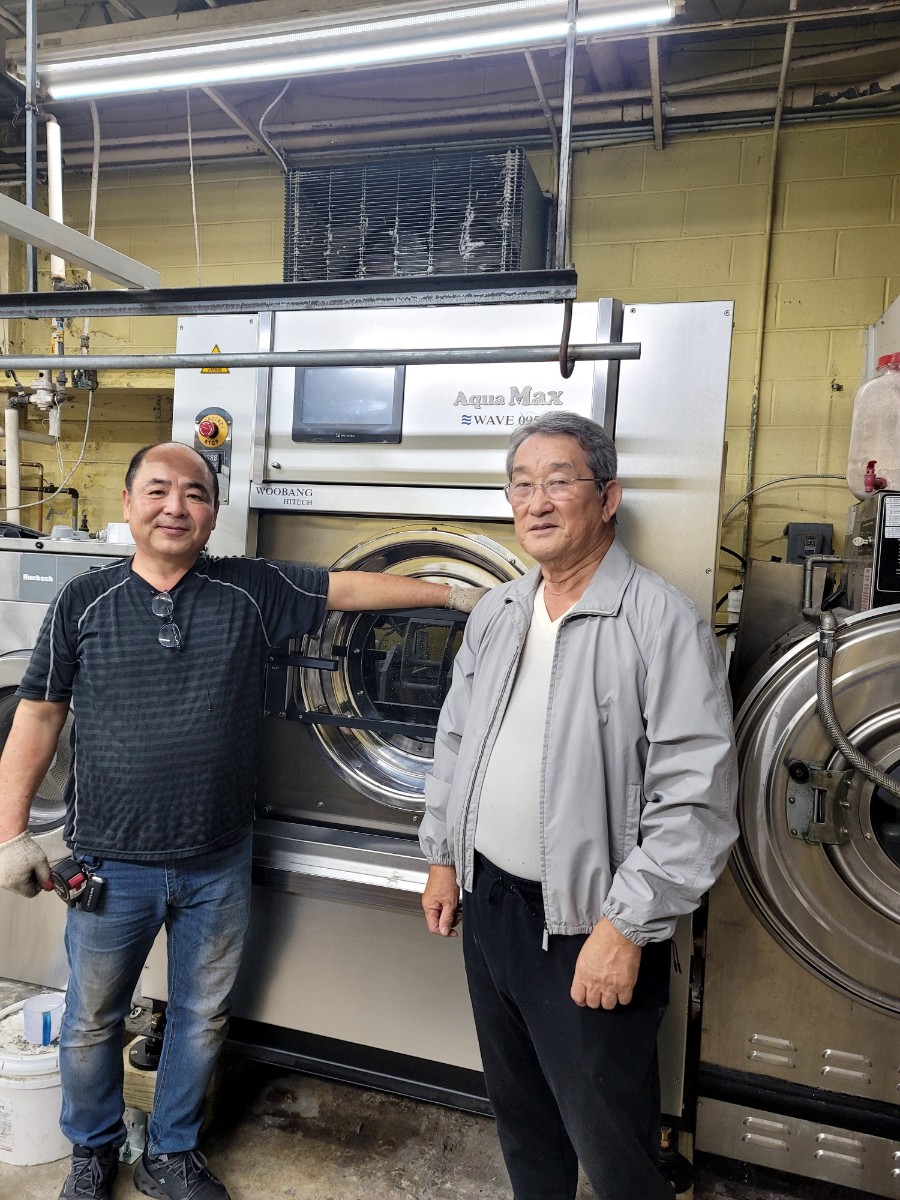
“With UniMac and other wet cleaning machines on the market, I couldn’t control the drum action the way I wanted. Then I saw an AquaMax advertisement and reached out. They told me the drum action could be controlled in one-second increments. I bought the machine without even seeing it in operation. Honestly, I thought, ‘Wet cleaning is wet cleaning—how different could it be?’” That was last October.
Because he already had extensive know-how, Mr. Ko assumed AquaMax only needed to cover the mechanical side. But after using it, he was surprised.
“I’ve built up a lot of experience through years of trial and error, but this was better.”
He says that with AquaMax, “you feel at ease.” By barely using drum action and instead relying on wave action (air bubbles), garments come out with no pilling or distortion. Wrinkling is dramatically reduced, and pressing is even easier than with dry cleaning.
“In the past, I still had to hang-dry one or two loads. Now I don’t hang anything at all. It’s exactly like using a dry cleaning machine. If what I knew before was second-generation wet cleaning, AquaMax is third generation or beyond. I really had no idea it was this good.”
Showing Off to Dry Cleaner Friends
As a first-generation dry cleaner in the area, Mr. Ko has many friends who still do dry cleaning. Many of them have come to learn wet cleaning, but when they saw garments being hung to dry, they question whether it’s really worth it.
“Honestly, they’re just scared. So, after installing AquaMax, I started calling them up. I told them, ‘You guys, come see this right now. It’s easier than dry cleaning.’”
About ten friends have come by so far. Some brought in difficult garments, washed them, pressed them, and were amazed, saying, “The pressing is better than dry cleaning.”
Every visitor said the same thing: “It’s no different from dry cleaning.” Mr. Ko even gave them AquaMax detergent and conditioner, encouraging them to try it themselves.
Yet not a single one has decided to switch to wet cleaning.
“Even when all you have to do is push a button, they still can’t make the change. Talking about it doesn’t help. People just don’t change their mindset easily.”
Higher Prices, Thanks to Better Results
Mr. Ko says that after the pandemic, only three dry cleaners remain in his area. Rents in Atlanta have also risen sharply, so cleaning prices have gone up as well.
“Before the pandemic, this was an area where shirts were $1.90 and pants were $4. Now shirts are $4.25, hand-pressing is $10, pants are $9.50, and suits run from $23 to $35.”
With AquaMax, garments come out smoother, and customers who prefer a “soft touch” especially love the results. Because clothes feel softer, wrinkles release more easily, and pressing quality improves significantly.
“There’s Nothing Special Left to Learn”
Over the past ten years of wet cleaning, Mr. Ko has learned everything imaginable about dyeing, fibers, weaves, and garment construction. There were many precautions to take, and no matter how skilled he became, the work was never truly easy.
“Now, there’s nothing left to be careful about. There’s nothing special left to learn. It’s become exactly like dry cleaning. The only difference is that spotting is much easier. Work speed is faster, and the job itself has become incredibly easy.”
He says that when he talks to dry cleaner friends about wet cleaning, they all worry about shrinkage. He emphasizes that “there’s absolutely no such problem.” With AquaMax, he even washes leather and suede—placing them in mesh bags and sometimes washing them together with textile garments—without a single dye-transfer incident so far (although the manufacturer recommends washing leather items separately).
Mr. Ko recalls that accidents were frequent in the early days of wet cleaning.
“I still have a red St. John’s knit outfit hanging here that I once ruined. I kept it as a reminder to always be careful. Now I think it’s time to take it down.”
“We’ve reached an era where even someone who knows nothing about wet cleaning can just load the clothes and press the start button. It’s faster and easier than dry cleaning. The time to switch has come. I was shocked when I saw the results. You’ll be shocked too.”
For detailed inquiries about this article, please call (205) 915-8228. ■