
Fire-tube, water-tube and tubeless boilers offer different advantages in startup, steam delivery and maintenance. Understanding those differences helps owners look beyond horsepower and purchase price.
When steam pressure drops, production feels it. Pressers wait, finishing slows and equipment struggles to maintain its normal pace. Yet choosing a replacement boiler involves more than matching the horsepower listed on the old machine.
A drycleaning plant needs a boiler suited to its working rhythm: morning startup, simultaneous equipment use, quieter periods and daily shutdown. The three principal fuel-fired designs—fire-tube, water-tube and tubeless—approach that job differently.
Fire-tube boilers place the combustion gases inside the tubes.
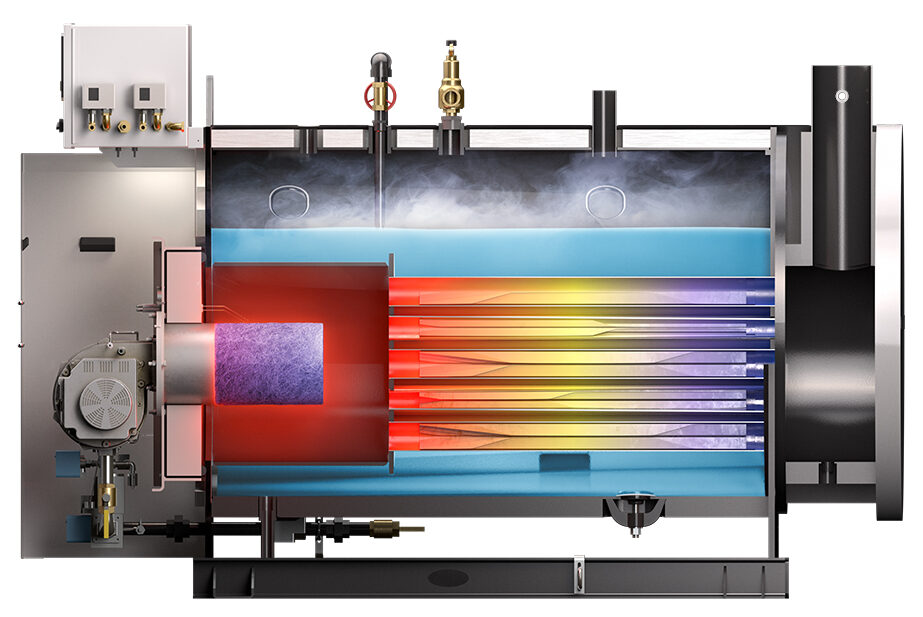
Water surrounds those tubes and absorbs heat through their walls. Depending on the design, the gases make one or more passes through the boiler before leaving through the exhaust.
Traditional shell-type fire-tube boilers contain a substantial amount of water. Once hot, that water stores energy that can help cushion a brief increase in steam demand. This is useful when several finishing machines call for steam together. The tradeoff is the time and energy required to heat that water during a cold start. Modern compact fire-tube models can behave differently, so the category alone does not establish startup performance. abma.com
For maintenance, accessible straight tubes offer a practical advantage. Opening the appropriate covers allows inspection and cleaning, and individual tubes can often be replaced. However, the boiler room must provide enough clearance for that work. A boiler that fits through the doorway may still be difficult to service after installation.
Rear-chamber construction also matters. Dryback boilers use refractory material where combustion gases reverse direction; wetback designs use a water-cooled chamber. Dryback construction generally offers convenient access but adds refractory maintenance. Wetback construction reduces that particular maintenance requirement, although access to the chamber can be more difficult. abma.com
A traditional fire-tube boiler is therefore worth considering where steam demand is sustained and sufficient installation and service space is available.
Water-tube boilers put the water inside the tubes.
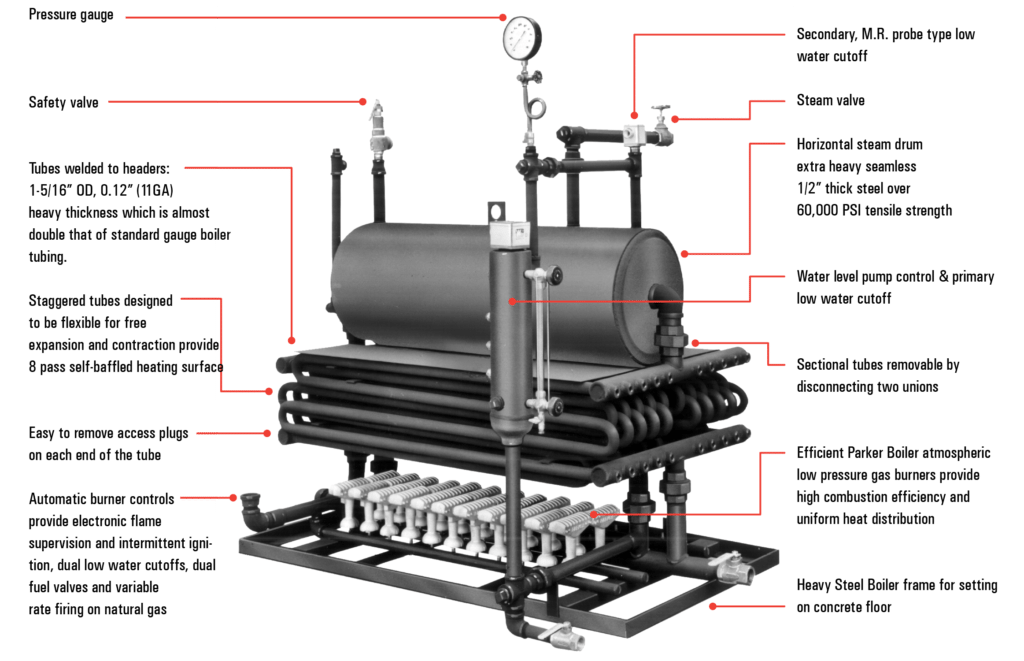
Combustion gases circulate around the outside, heating water that moves through tubes connected to drums or headers. For drycleaners, the relevant comparison is usually with compact commercial models rather than large industrial water-tube installations.
Many small water-tube boilers raise steam quickly. Less water generally means less energy is needed to bring the boiler up to operating conditions. Some commercial models advertise cold-start performance of less than ten minutes to 100 psi, although actual results depend on the equipment and starting conditions. parkerboiler.com
That can be attractive to a plant that shuts down every evening. However, fast startup and resistance to sudden demand are separate characteristics. A small water inventory provides less stored energy, making burner response, feedwater control and proper capacity selection especially important.
Repairability is another potential strength. Some water-tube designs use individual sections connected by unions. A damaged section can be removed through the cabinet and replaced without replacing the entire pressure vessel. Flexible bent tubes also accommodate expansion and contraction during heating and cooling. These advantages depend on the particular construction; not every water-tube boiler offers the same access or replacement procedure. Parker Boiler
Owners evaluating this design should ask how a tube section is replaced, whether replacements are stocked locally and how much downtime the work normally requires.
Tubeless boilers eliminate the conventional tube bank.
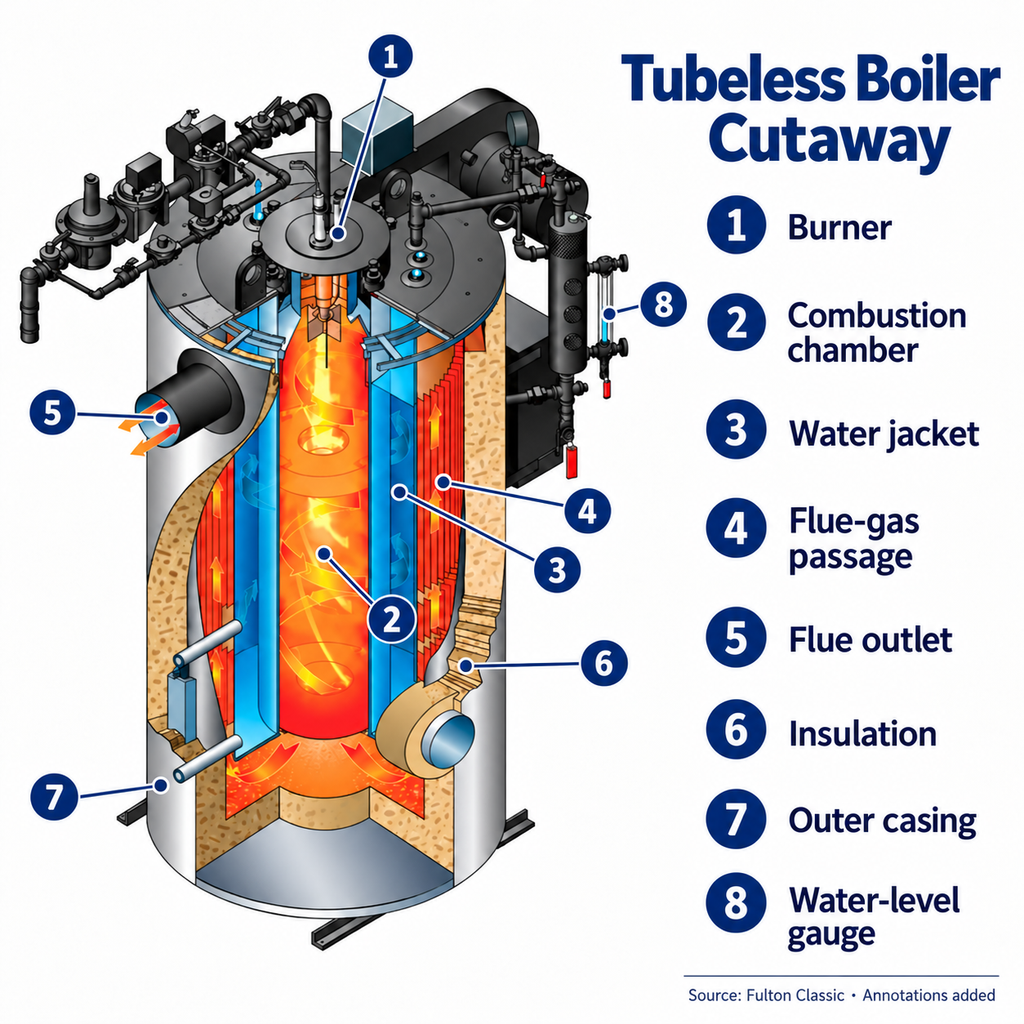
In a typical vertical design, water occupies a vessel surrounding the furnace. Combustion gases transfer heat through the vessel walls and additional heating surfaces, such as fins, before reaching the exhaust.
The arrangement is well suited to plants where floor space is limited. It also eliminates conventional retubing work. Nevertheless, tubeless boilers vary considerably: burner placement, gas passages, heating surfaces and refractory requirements differ between models. Some newer designs use fully wetted, refractory-free construction. Fulton
The absence of tubes does not eliminate service requirements. Burners, water-level controls, gas passages and any fitted baffles or refractory still need inspection and maintenance. Nor does it make every repair inexpensive. Serious damage to the main pressure vessel can require a more substantial repair-or-replacement decision than replacing an individual tube.
For a tubeless installation, owners should check overhead and side clearances as carefully as floor dimensions. Burner removal and access to internal components must remain possible once piping and other equipment are installed.
Water treatment affects every design.
Scale forms an insulating layer between heated metal and boiler water, reducing heat transfer and potentially contributing to overheating and premature failure. Corrosion can damage tubes, vessels and other components. Proper feedwater treatment helps control these problems, along with foaming and solids carried into the steam. Fulton
A water softener, chemical treatment and blowdown serve different purposes. Their requirements should be established for the particular boiler and water supply. Neither a large water chamber nor a tubeless label makes neglect harmless.
Reliability also extends beyond the pressure vessel. A sound boiler can still stop production because of a failed feed pump, burner control or water-level device. Local service capability and parts availability deserve a place alongside construction quality in the purchase decision.
Efficiency should be judged against the plant’s operating schedule.
A published efficiency figure describes specified conditions. The owner pays for the entire day, including warmup, idle periods and repeated burner starts.
Ask suppliers to compare fuel use at the expected load, explain the burner’s minimum firing rate and identify how the controls respond as demand changes. Avoid selecting extra capacity without examining the consequences of operating well below that capacity.
Likewise, equal boiler horsepower does not mean equal water volume, startup time or footprint. Compare actual steam output at the required operating conditions and obtain the normal operating water content for each proposed model.
No defensible lifespan ranking places every fire-tube, water-tube or tubeless boiler ahead of the others. Water quality, operating conditions, maintenance and repairability all influence useful life. A long warranty against one failure mechanism should also be distinguished from coverage of the complete boiler.
The purchase decision should ultimately reflect the plant’s priorities. Stored heat may matter most where demand arrives in sharp bursts. Quick startup may carry more weight in a plant with a short working day. Compactness and accessible repairs may be decisive in a crowded boiler room. A properly sized boiler, supported by consistent water treatment and dependable local service, gives those design advantages a chance to translate into uninterrupted production.
