
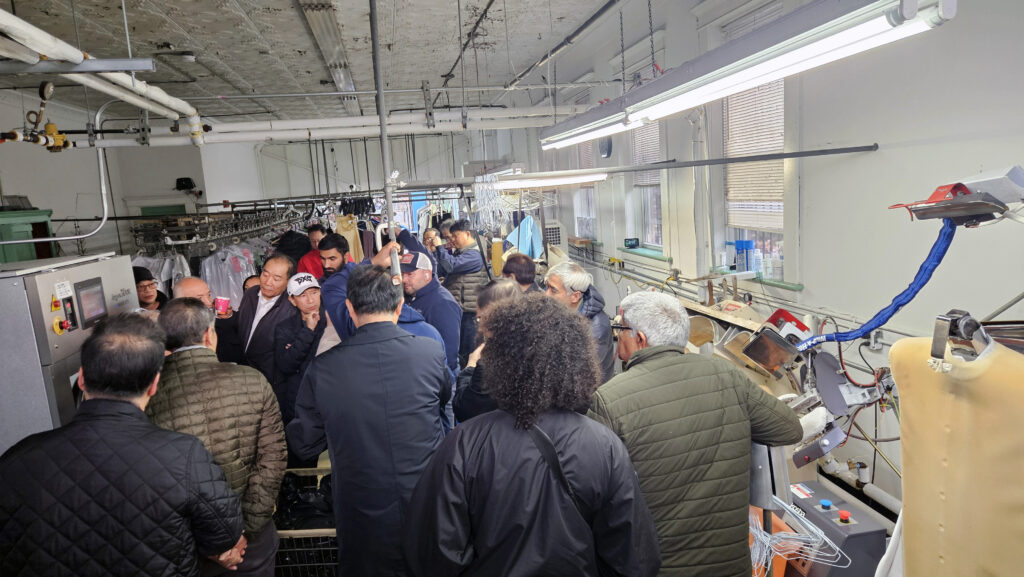
If you ask a traditional dry cleaner this question, most of them will immediately shake their heads. That’s because of the common belief that wetcleaning is labor-intensive, time-consuming, and difficult to press. On November 23, however, a seminar was held at Kimber Cleaners in South Amboy, New Jersey, demonstrating the real working environment of a 100% wetcleaning shop. The seminar didn’t teach wetcleaning techniques—it simply showed wetcleaners working as they actually do, with no lecture at all.
Shop owner Jangkeun Cho said, “I removed my hydrocarbon machine and installed a wetcleaning machine, so I think I’m qualified to speak about this,” emphasizing, “Since switching to wetcleaning, my workload has actually decreased.”
Cho explained, “I barely spend any time spotting anymore. I just wash the load, and if any oil stains remain, I apply an oil remover and wash it again—that’s it. I graduated from the old ‘chik-chik-pok-pok’(jargon for stain removal work) routine completely.”
During the demonstration, three different loads were processed: a dark load, a dark-and-light mixed load, and a knitwear load. Attendees inspected garments before washing, loaded the machine, and started the programs themselves.
Five neckties were also included in the first load, placed inside a net bag. Cho said, “Even dry cleaners usually hand-wash ties, right? I process everything in the wetcleaning machine.”
During the wash cycle, attendees were able to watch the AquaMax wetcleaning machine’s WAVE action. The drum barely rotated, yet strong air-bubble motion from below kept the garments constantly moving—a sight that impressed the audience.
Once washed, the garments went straight into the dryer. Only the ties were taken out and hung to air-dry. “Ties tend to pop their stitches if you tumble-dry them,” Cho explained.
The second load mixed darks and lights to show how low the risk of color bleed is.
After the second load, attendee Albert Lee asked to process his leather jacket. AquaMax can wash leather items, but because leather must be air-dried and cannot be worn immediately, Cho used the steam-only cycle, which uses no water at all—only steam—to remove odor and refresh the garment.
Cho explained, “If the garment is already clean, or vintage, or for any reason feels risky, we run it on steam-only. And if there’s an item that cannot even be processed by this cycle, it means the item cannot be cleaned by any method.”
The third load contained sweaters, scarves, and cardigans—knit items. These were washed without special pre-treatment and then dried. “Sweaters usually need almost no finishing once they come out of the dryer,” Cho noted.


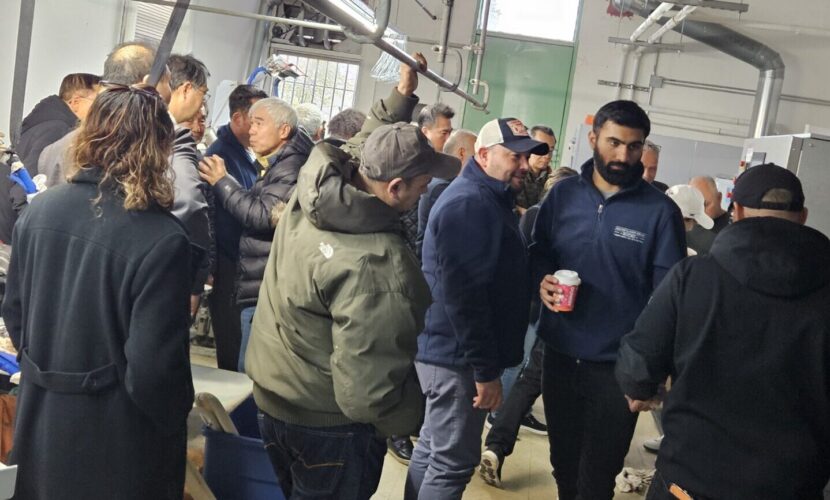
Interestingly, most of the attendees were Americans.
▲ Giovanni, a cleaner from Lower Manhattan, said:
“I stopped using my old perc machine and have been relying on a wholesaler. I wanted to buy a new drycleaning machine, but no equipment company was willing to take on the installation work in NYC. That’s why I came to see the AquaMax system.”
He added, “Honestly, I never thought wetcleaning was a viable option. But I touched the garments before they went into the dryer, and I was shocked at how smooth and wrinkle-free they were. My brother runs a drop store, and I’m confident I can handle his volume too.”
▲ Frank, who works in fire-restoration services, said:
“To remove smoke odor, water washing is essential. Right now, I water-wash items and then dry-clean them again. But with results like this, I won’t need to dry-clean afterward.”
▲ David, who uses a 20-year-old perc machine in Brooklyn, said:
“I know too many friends who switched to hydrocarbon and suffered terrible odor issues. That’s why I keep spending money to maintain my old perc machine. I never imagined wetcleaning could produce results like this.”
▲ Wetcleaning expert Myungsik Son commented:
“You should trust the people whose sales increased after switching to 100% wetcleaning. Stories from anyone else are simply stories of failure with wetcleaning. A machine that does wetcleaning at the push of a button—that’s revolutionary.”
He added, “Dry cleaning requires cooking, filter changes, odor control, environmental inspections—it’s exhausting. Wetcleaning is possible even at age 90. You can comfortably enjoy the later years of your life while making money without much effort.”
▲ Sungjae Hong of CleanAir Supply added:
“I sold a drycleaning machine in Lower Manhattan, and the permit work alone took two years. Now the co-op board is dragging the approval process for nearly a year.”
▲ Plimio, who runs a DCE equipment company in Brooklyn, said:
“In all five boroughs of New York City, installing a new drycleaning machine is extremely difficult. The permit process alone takes more than a year. I don’t even take on NYC jobs anymore.”
“With a system like this that perfectly replaces dry cleaning and is easy to install, it’s a lifesaver for NYC cleaners.”
“A 55-lb drycleaning machine now costs over $100,000, and that price tag is barrier for a lot of cleaners. Also, NYC requires sprinkler installation too, which alone costs $60,000–$80,000.”
Final Comments
Owner Cho said, “I’ve researched wetcleaning extensively and gone through countless trials and errors. Who would have imagined a day when wetcleaning could be done at the push of a button?”
He added, “I’ve used the AquaMax wetcleaning system for about four months now. The work is two to three times faster than with drycleaning, spotting is almost unnecessary, and finishing is much easier. At this point, insisting on drycleaning is the same as insisting on making your own work harder.”
