One of the most common—and costly—issues encountered in finishing machinery is continuous steam leakage through the buck valve of a press. This condition can result in the following problems:
- Fabric becomes excessively damp, preventing effective vacuum drying
- Pressing results become inconsistent
- Surface defects such as shine, impressions, or water spotting may occur
- The service life of the press pad is significantly reduced
- Operators are unable to consistently achieve a crisp, professional finish
If not corrected, this condition will result in increased rework, higher finishing costs, and potential customer dissatisfaction.
To address this issue, this series provides detailed information on buck valve operation, troubleshooting procedures, and the techniques, parts, and tools required for proper repair.
Before proceeding, it is important to understand how this family of valves operates. For reference, this guide uses the United Brass Works buck valve, which is commonly installed as a cost-effective replacement for the more expensive versions supplied by original equipment manufacturers (OEMs).
Although this valve is air-operated, its function is similar to that of many mechanically operated buck steam valves. Differences between designs will be addressed only when they are relevant to valve operation.
TYPES OF PRESSES ENCOUNTERED IN DRY CLEANING OPERATIONS
Two primary types of presses are commonly found in dry cleaning plants.
1. Dry Cleaning Press (Soft Finish Press)
This type of press is used for most dry-cleaned garments that do not require a hard finish, such as trousers, coats, jackets, skirts, and dresses. It is equipped with steam control valves located in both the head and the buck:
- Head: The upper section of the press that closes to apply pressure to the garment
- Buck: The stationary lower section against which the head closes
These valves regulate the flow of steam through the garment during the pressing cycle, ensuring controlled, consistent finishing results.
2. Laundry Press (Hard-Finish Press)
This type of press is used for garments that are typically washed and for fabrics that require a hard finish, such as shirts, uniforms, and flatwork. Unlike the dry cleaning press, it typically has either no steam valves or only a head steam valve.
In this configuration, the buck does not normally control steam flow. Instead, it plays a critical role in drying and finishing by evaporating residual moisture from the garment.
DRY CLEANING PRESS BUCK CONSTRUCTION
Let us begin by examining the construction of the typical buck found in dry cleaning presses. At first glance, the buck appears to be a simple oblong metal component with a series of holes across its surface. Steam passes through these holes when the operator activates the foot pedal.
In reality, the buck is a more complex assembly designed to distribute steam evenly and facilitate effective moisture removal. Several internal components work together to achieve this function.
Internal Construction and Function
Steam Chamber
Beneath the surface of the buck is an internal steam chamber. This chamber heats the buck and is connected to the buck valve. When the steam valve is activated, steam is released and evenly distributed across the entire surface area of the buck.
Perforated Surface (Top Plate)
The outer surface contains multiple small holes that allow steam to pass uniformly through the garment. Even distribution is critical to prevent uneven pressing or water spotting.
Screen or Diffuser Plate
Many bucks include a screen or diffuser positioned above the top plate. This component helps distribute steam evenly and prevents concentrated bursts that could damage fabric or cause water spotting.
Padding and Cover (Pad)
The buck is covered with padding and a fabric cover, commonly called the pad. These layers:
- Protect the garment from direct contact with the metal surface
- Help distribute pressure evenly
- Allow steam to pass through while maintaining proper shaping support
A vacuum section is also incorporated into the buck design; this will be addressed in a subsequent section.
Operational Note:
Proper buck performance depends on uniform steam distribution. Any obstruction, leakage, or uneven flow within the buck can result in poor finishing quality, excessive moisture retention, and fabric finish defects.
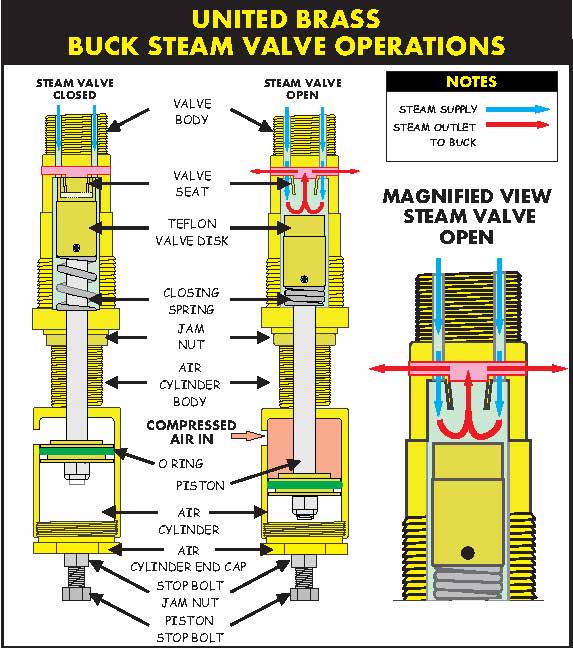
Now that we’ve covered the basics of what a buck is, let’s drill down and discover just how the buck valve actually controls the steam flow through the buck (use the accompanying illustration to more easily visualize the operation of the valve). With air (pneumatically) operated valves, there are twTop of Form
o modes of valve operation: open or shut. When the valve is shut, the Teflon valve disk is held firmly against the valve seat by the closing spring, preventing steam from flowing through the valve body into the buck.
When the valve is in the open position, compressed air is introduced into the air cylinder, pushing the piston into the cylinder, overcoming the force of the closing spring pulling the valve stem and Teflon disc away from the valve seat.
As the disc moves off the seat, a flow path is created through the valve body, allowing steam to pass into the buck’s external steam chamber. From there, the steam is evenly distributed across the buck surface and throughout the garment.
Actuation Sequence:
- The operator activates the control pedal or button
- The pneumatic control system directs compressed air to the air cylinder
- Air pressure forces the valve stem downward, compressing the closing spring
- The Teflon disc lifts off the valve seat, opening the valve
- Steam flows through the valve body and into the buck
When the control is released:
- The air supply to the actuator is vented
- The closing spring forces the valve stem and disc back onto the seat
- Steam flow is immediately shut off
Operational Note:
Proper valve performance depends on smooth movement of the valve stem and a tight seal between the disc and seat. Any wear, contamination, or misalignment can result in incomplete closing and continuous steam leakage. These conditions will be explored in a following issue.
That concludes this month’s installment. In the next issue, we’ll take a closer look at the most common buck valve failure points—and the practical steps you can take to diagnose and correct them before they impact production quality and costs.
Well, that’s it for this month. Stay tuned for the next issue, where I’ll delve into the problem areas of the buck valve and how to fix them.