I met Ms. Kim again after a long time. Now in her early seventies, she stands in the later chapter of life. She came to the United States in her youth when her husband pursued studies abroad. As a struggling student couple, they began a demanding life working at a dry cleaner—she at the press and the counter. She was more sincere than anyone and worked harder than anyone. There was always more to be done, and responsibility was never light. She hurried constantly, afraid that even a small delay would leave her behind, never allowing herself even a brief pause. To achieve more, to build a more stable life, and to earn recognition from others—this was what she believed to be “living well.”
Life as international students was so difficult that her husband eventually gave up his studies and joined her in the dry-cleaning business. The business flourished. They operated multiple plants and drop-off locations, riding a path of success as immigrants. They owned a luxurious home with a three-car garage, drove a Mercedes, filled their closets with diamonds, mink coats, and Chanel handbags, and raised children who graduated from top universities to become a doctor and a lawyer. They had everything the world might envy. Yet even so, a quiet thirst and emptiness lingered in her heart.
In her mid-fifties, a quiet change began within her. It did not come from any dramatic event but from small, ordinary moments—almost like something gently seeping in. One day, while organizing her closet, she found herself standing still for a long time. Looking at her neatly arranged clothes, a thought suddenly came to her: “Why do I have so much?” She had more than enough—too much, in fact. Yet she only wore a few pieces regularly. In that moment, she realized that she had accumulated so much not out of necessity, but to show others—or because she believed that was the “right” way to live.
From that day on, she began to let go, little by little. Not only clothes, but also the standards by which she had lived. In the past, she had been highly conscious of how others perceived her. Every word she spoke, every decision she made was filtered through the question, “How will this look?” But over time, she came to understand that the world does not change much even if one stops trying so hard to manage appearances. In fact, the moment she released that burden, her heart felt much lighter.
She had believed that maintaining appearances protected her, but she realized it had actually been binding her. Another thing she began to release was the past. She often defined herself by saying, “Back in the day, I…” believing that her past achievements would sustain her present. But one quiet day, sitting alone, she asked herself, “Is that really sustaining who I am now?” The answer was not clear, but her heart knew: the past may be a precious memory, but it cannot live the present for her. The more she lingered in the past, the more her present life seemed to fade.
So, she began to speak less about the past and focus more on living today. Yet what held onto her the longest was comparison—measuring who lived better, who was further ahead. Comparison pushed her to strive harder, but at the same time, it made her feel perpetually lacking.
One day, she sat on a park bench and noticed an elderly man. He was sitting alone, quietly smiling in the sunlight. There was nothing particularly remarkable about him, yet his expression held a peace that was difficult to explain. As she watched him, she suddenly realized: that peace came from not comparing. He wasn’t measuring himself against anyone—he was simply accepting the moment as it was.
From that day on, she began to let go of comparison, little by little. And in its place, a quiet but deep sense of peace began to settle within her. By her mid-fifties, she had learned how to let go.
After turning sixty-five, she learned something new: how to manage the rhythm of life. She still had the habit of rushing; with responsibilities she found difficult to set aside. But her body was no longer what it used to be. One day, after pushing herself too hard, she was left in deep exhaustion for several days.
That experience brought an important realization: strength is not about constantly pushing forward, but about knowing one’s own pace.
She began to reorganize her days. In the morning, she no longer rushed. She sat quietly with a cup of tea, read the Bible, and prayed for those going through difficult times. She gave thanks for the simple blessing of starting the day in health, looking out the window at the morning light. That short time became the center that steadied her entire day.
She also learned how to stop. Unlike before, when she would endure through difficulty, she now checked in with herself first. If her body was tired, she rested. If her heart felt heavy, she paused. She came to understand that this was not giving up—it was wisdom for living longer and more steadily.
She developed a small habit: asking herself several times a day, “What state am I in right now?” Though simple, this question became a guiding center that protected her life. Gradually, she began to value her inner state more than external conditions.
As time passed and she approached seventy-five, her life became even simpler. Many things that once seemed important naturally faded away. In their place, the most basic things began to sustain her life: waking up on her own, stepping outside on her own feet, and feeling the sunlight. She deeply realized how great a blessing these ordinary moments are.
She also came to understand the meaning of relationships differently. It wasn’t about having many people, but about how precious it is to have even one person with whom you can share your heart. One day, she had a short phone call with an old acquaintance. It wasn’t a special conversation, but after hanging up, her heart felt warmly filled. That brief connection changed her entire day.
Above all, she came to clearly see that the state of one’s heart determines life. A heart that does not easily waver, that does not compare, that does not dwell on the past, and that accepts the present—this is what matters.
She was not perfect. Sometimes comparison crept back in, and sometimes she felt regret about the past. But now it was different. She could recognize those moments and return to herself again.
One quiet day, she opened the Bible and read a verse:
“Love the Lord your God, listen to His voice, and hold fast to Him. For He is your life and the length of your days.”
That verse stayed deep in her heart. She had spent so long trying to hold onto many things, but she realized that what sustains life is something else entirely.
She made a decision:
to rely more deeply on God rather than striving to have more,
to live rightly before God rather than trying to look good before others,
to walk at her own pace within His word rather than rushing in anxiety,
and to live each given day with gratitude rather than clinging to the past.
Outwardly, her life may not have changed much. But at its core, everything was different. She now understood that the later years of life are not a time to grasp more, but a time to firmly hold onto the one most important thing.
And that one thing was clear:
to love God, follow His word, and rely on Him.
Standing on that decision, the remainder of her life began to flow more quietly, more firmly, and more peacefully than before.
This special meeting with Ms. Kim reminded me once again how to set the direction of my own life. In that sense, the later years are not a time of weakness and sorrow, but a blessed beginning—where life ripens beautifully based on all that has come before.
Before we know it, May—the queen of seasons—has arrived. Flowers are in full bloom, and the songs of birds are especially delightful. Like this beautiful season, I hope our lives, too, will be gently and beautifully colored this May.
To all the readers of Cleaners Monthly, I sincerely cherish you.
Smile and laugh a lot!
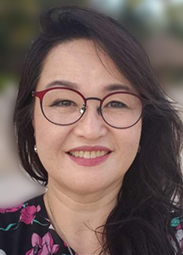
Carol Nam
The author works at Diamond Computer. For more info, call (224) 805-0898.