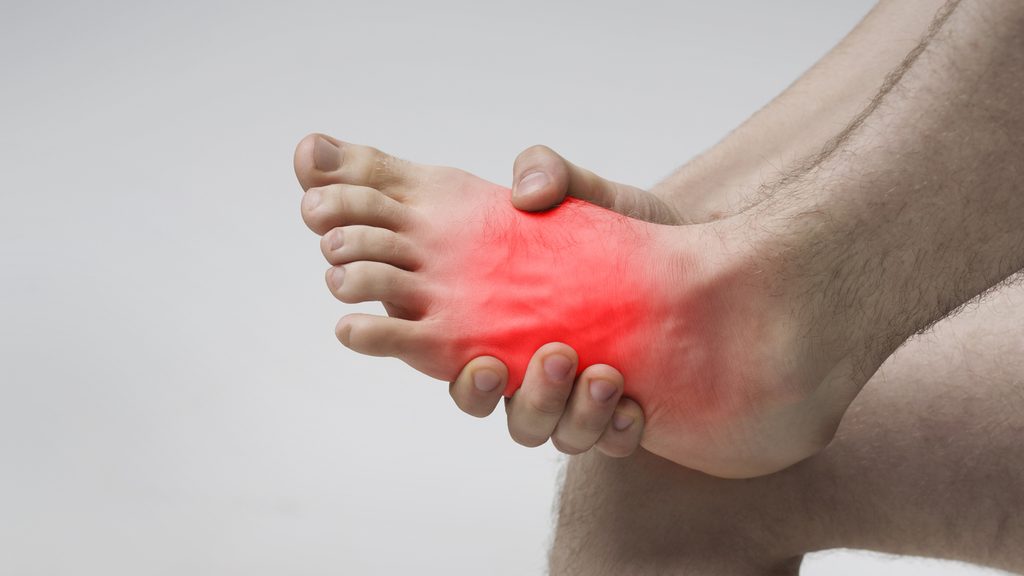
Lynn Pierce’s feet really hurt, and there are reasons for all that pain. The pain in her heels is related to walking. The tingling in the balls of her feet probably comes from years of playing racquetball. And one of her toe joints is slightly larger than normal. It is not causing trouble now, but it could become a problem later.
Pierce is certainly not alone. According to the American Academy of Orthopaedic Surgeons, some 43 million Americans suffer from foot problems. That enormous number is hardly surprising. Over a lifetime, we walk an average of 70,000 miles. We also frequently walk on hard surfaces in poorly fitting shoes while carrying heavy loads. Considering what our feet endure, it is perhaps more surprising that these structures—each containing 26 bones, 33 joints, and a complex network of muscles and connective tissue—do not develop even more problems.
Simply resting your feet may not resolve the trouble. Pain in the foot does not necessarily originate there. Dr. Paul S. Cooper, director of the Foot and Ankle Center at Georgetown University School of Medicine in Washington, D.C., points out that foot pain may stem from the Achilles tendon or calf muscles. Problems in either can restrict ankle movement, placing painful stress on the front of the foot.
Rest helps. But a more fundamental approach is to pay greater attention to foot care. Here are some common foot problems and ways to address them.
Tired Feet
If your job requires standing in one place, such as behind a sales counter, chances are your feet become tired and sore. Dr. Frank Myers of Ohio University explains that few things are worse for the feet than standing in the same spot all day, because the muscles remain static instead of stretching and contracting.
In this situation, try placing a telephone book on the floor and repeatedly stepping up onto it and back down. This provides some of the movement your feet need. Alternatively, repeatedly raising and lowering your heels while standing in place is also a useful exercise.
Removing your shoes and gently rolling a golf ball under the sole of your foot provides an excellent massage. Carol Frey, an assistant professor at the University of Southern California, notes that a minute or two of golf-ball massage is an excellent way to relieve stress in the soles.
Heel Pain
Heel pain is most often the result of repetitive stress. Repeated strain causes small tears in the tissue attached to the heel, eventually producing pain that can become difficult to bear.
The tissue involved is a springlike band running from the heel to the toes. Bend your toes upward, and you can see the thick band become prominent.
When this pain occurs, stretching the strained tissue can help. Dr. Lisa Degner, an orthopedic surgeon at the University of Kentucky, recommends stretching the tissue along the sole at least eight times a day.
Try a stretch commonly used by runners. First, remove your shoes and stand facing a wall. Place your hands against the wall, keep your left leg straight, and move your right foot forward while bending your right knee. Keeping your left heel on the floor and your left leg straight, lean forward as far as you can. Repeat the movement, alternating legs. This stretches the calf muscles and Achilles tendons.
Another inexpensive approach is to take ibuprofen, which reduces inflammation and pain, and soak your feet in warm water. Shoe inserts sold in shoe stores can also help. Obtaining these inserts through a foot specialist is preferable.
Pain in the Ball of the Foot
Pain in the ball of the foot—the area at the base of the toes—is known medically as metatarsalgia. Its causes range from nerve damage to shoes with overly narrow toe boxes or excessively high heels.
Start by switching to shoes with a wider toe box and lower heels. To help relieve the pain, place a pad just behind the weight-bearing area at the front of the foot. If you cannot give up high heels entirely, reserve them for formal occasions.
Toenail Problems
Toenail infections often begin with a stubbed toe. Dr. Howard Palamarchuk of Pennsylvania’s foot hospital points out that an impact can separate the nail from the underlying skin, creating a space where fungi can grow.
The solution is surprisingly simple: keep your toenails neatly trimmed. Do not cut them so close that you injure the skin, but leave the edges as smooth as possible. If a fungal infection has already developed, consult a specialist for an appropriate medication to apply.
Ingrown toenails are another common problem that can often be prevented. Podiatrist Harry Baldinger notes that improper nail trimming is frequently the cause.
The first rule is not to use fingernail clippers on your toenails. Their cutting edges are too short for toenails and may leave sharp corners. These sharp edges can pierce the skin and grow into it. The solution is simple: buy a large pair of toenail clippers.
Other Foot Problems
When too much pressure is applied to one spot on the foot, the skin hardens into a small lump about the size of a kernel of corn. Aptly called a corn, it usually develops on top of or between the toes, most often because shoes are too tight.
For temporary relief, cover the area with gauze or an adhesive bandage to prevent further friction. Then soften the corn with oil and gently rub it down with a pumice stone.
Calluses usually develop on the soles, where pressure is greatest. The remedy is to soften the hardened skin with oil and then gently file it down. Metatarsal pads for these problems are available at pharmacies.
A bunion is a swelling or bony prominence at the base of the big toe that can cause severe pain. Bunions are often hereditary, but they can also develop from wearing shoes with narrow toe boxes, such as women’s dress shoes. Wearing shoes with ample room at the front can help address the problem.
Hammertoes can develop when the second toe is longer than the big toe and is compressed by poorly fitting shoes. A protective splint can be purchased at a pharmacy.
Of course, no single piece of advice can cure the many problems that affect the feet. But following these suggestions as part of your daily routine can help prevent many foot problems before they begin.