This month, I’ll continue on solvent flow by discussing the heart of the solvent flow system, the solvent pump. Most dry-cleaning machines use a centrifugal solvent pump. It is a mechanical device designed to move solvent using a motor that rotates a disk-like device called an impeller with vanes on its surface. Fluid enters the rapidly rotating impeller at its center and is cast out by centrifugal force along its circumference through the impeller’s vane tips.
PROBLEMS CAUSED BY PUMP FOULING
As we are all painfully aware, the list of junk that solvent washes through the dry cleaning machine is endless. Buttons, lint, pens, pencils, credit cards, collar stays, pins, coins, and the list goes on and on. Hopefully, the button trap strainer will catch most of these objects. As we all know, nothing is 100%, and some debris will get through; when it does, in most cases, the pump’s impeller will chop it up and pass it through, where it will eventually be trapped in the filter or still. However, when the pump can’t chew it up and spit it out, debris often slowly accumulates between the vanes on the pump’s impeller. This accumulation is a cascading process (like a snowball rolling downhill); once it begins, it rapidly degrades the pump’s performance. The following are the most common symptoms when debris is fouling the solvent pump’s impeller, and they fall into two basic categories: electrical and dry cleaning quality.
ELECTRICAL
CASE 1—When an object locks up the impeller, preventing it from rotating, the pump motor’s excess current draw almost immediately leads to overload tripping. On most dry cleaning machines, this causes the machine to shut down and display an error message.
CASE 2- When there is a significant debris build-up in the impeller vanes, it “drags” on the motor. After a few minutes of operation, the motor overload trips, causing the machine to shut down and display an error message.
CASE 3—When debris builds up in the impeller vanes, a reduced flow rate during the drain period results in the solvent level not dropping below the dry cleaning machine basket. Then, when the extract motor turns on, it tries to spin the basket through the solvent; the extra drag causes the extract motor overload to trip. This debris build-up may be in only one or two impeller vanes, causing the extract motor overload to trip intermittently.
CLEANING QUALITY
When debris clogs the impeller, the pump moves less solvent. This reduced flow rate can cause any or all of these undesirable effects.
GREYING (REDEPOSTITION)- With less solvent flushing through the garments in a given time, particulates that would usually be suspended in the solvent and then carried to the filter or still, will settle back out of suspension onto the garments, resulting in greying. Also, suppose the basket attempts to rotate through the solvent remaining in the wheel. In that case, it agitates the solvent, splashing it against the tub’s sides and washing old accumulated debris onto the garments.
POOR FILTRATION- Another symptom of pump problems is poor filtration. Flow rate through the filters is paramount to good cleaning quality. The solvent pump must overcome the filters’ resistance to the solvent flow. This resistance is called filter pressure. When the vanes of the solvent pump become fouled, the pump’s ability to force solvent through the filter drops, reducing flow rate and causing the attendant greying effects outlined above.
CHECKING PUMP PERFORMANCE
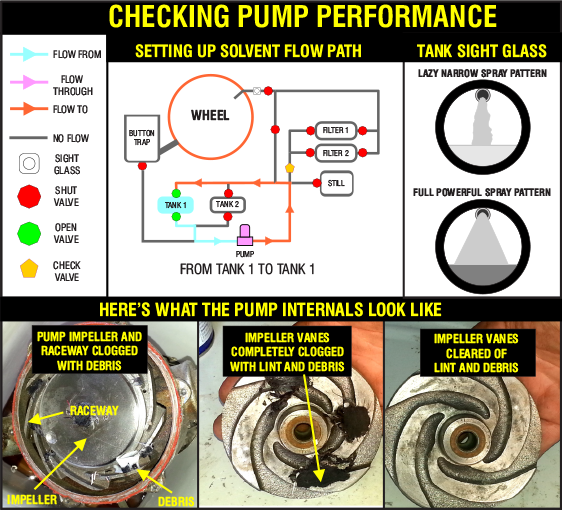
A method I’ve always found handy to check pump performance is to set up the flow path so solvent is pumped from a tank back to the same tank while watching the spray pattern across the tank sight glass. The area the spray fans out over the sight glass is a good barometer of the solvent pump performance. The accompanying illustrations show the valve setup for the spray pattern check and the pump’s internals.
Well, that’s it for now. More on valves next time around.