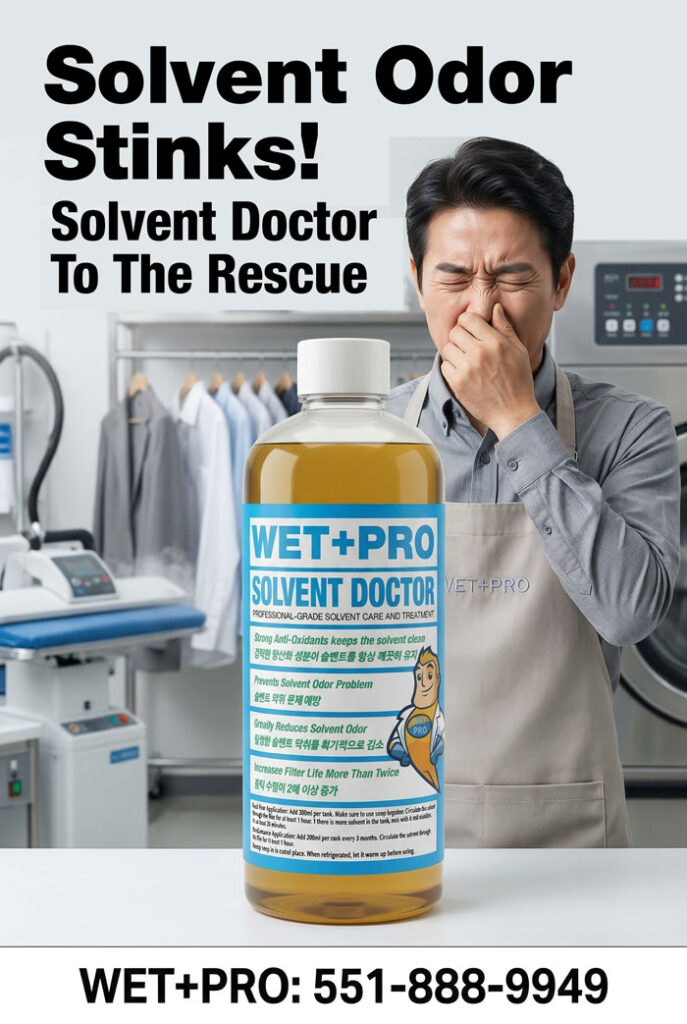
Unless the root cause is eliminated, the odor problem will continue to return
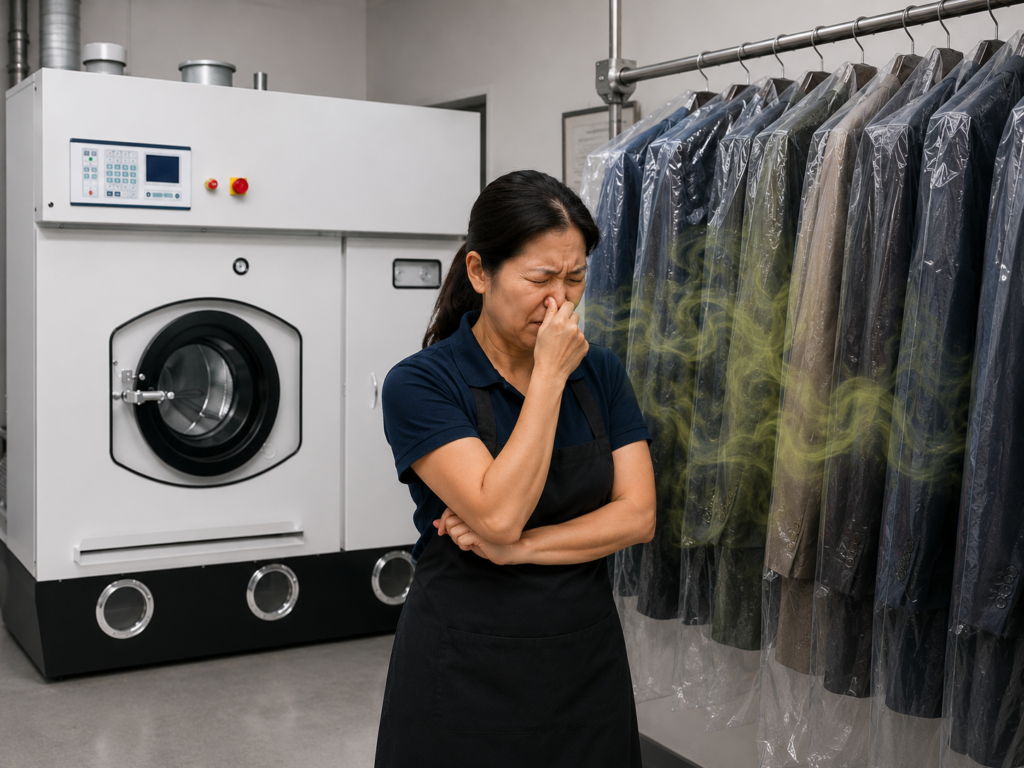
Hydrocarbon solvents are gaining worldwide acceptance because they offer environmental and workplace safety advantages over perc. However, one of the most common problems experienced by cleaners using hydrocarbon solvents is solvent odor.
A solvent that initially causes no problems may, over time, begin to develop a sour, musty, or rancid odor. In severe cases, the unpleasant smell can remain on garments even after they are removed from the machine. Customers often describe the problem by saying, “The clothes smell moldy,” “They smell like sweat,” or “The dry-cleaning smell is strange.”
In most cases, this odor does not occur naturally. It is the result of inadequate solvent management.
Moisture Is the Biggest Cause of Odor
Hydrocarbon solvent does not mix with water, but a certain amount of moisture inevitably enters the system during the cleaning process.
Common sources of moisture include:
▲ Sweat and moisture remaining in garments
▲ Steam use
▲ Condensation in air lines
▲ Inadequate water separator maintenance
▲ Declining still performance
Hydrocarbon solvent itself is an environment in which microorganisms have difficulty multiplying. However, when water accumulates in the solvent, the situation changes.
Bacteria and microorganisms begin to multiply in the water layer. As they break down fats and proteins released from garments, they produce fatty acids and various odor-causing substances. These byproducts contaminate the solvent and eventually leave odors on the garments.
Because hydrocarbon solvent can provide a more favorable environment for bacterial survival than perc, proper moisture management and antimicrobial control are particularly important.
Replacing the Filter Alone Does Not Solve the Problem
When an odor problem develops, many cleaners replace the cartridge filter as their first response.
An old filter can certainly contribute to odor. However, if the entire solvent tank has already become contaminated, replacing the filter alone will not solve the problem. The odor will eventually return.
Solvent odor problems are generally caused by a combination of factors, including:
▲ Accumulation of fatty acids in the solvent
▲ Growth of bacteria and microorganisms
▲ Insufficient distillation
▲ Poor water separator maintenance
▲ Contaminated sludge at the bottom of the tank
▲ Oxidized solvent
Therefore, unless the underlying causes are eliminated, the odor will continue to return. Within the industry, insufficient distillation and the accumulation of non-volatile residue (NVR) are also identified as major causes of declining solvent quality and odor problems.
Prevention Is the Most Economical Solution
Once an odor problem becomes severe, a cleaner may have to replace the entire solvent charge or clean the tanks.
However, most problems can be prevented through proper routine maintenance. Basic preventive measures include:
▲ Check the water separator frequently and remove accumulated water.
▲ Distill at least 10 gallons of solvent for every 100-pound load of garments.
▲ Replace cartridge filters according to the recommended schedule.
▲ Remove lint and sludge regularly.
▲ Do not leave solvent sitting unused for extended periods.
▲ Use recommended antioxidant and antimicrobial additives on a regular basis.
Recently, there has been increasing use of antioxidant-based additives designed to inhibit fatty-acid formation and reduce the growth of microorganisms. Such products may help prevent odor from developing in the first place while also extending solvent life.
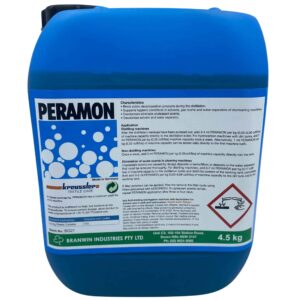
▲ Peramon: Supplied by German company Kreussler, this product binds with organic acids in the solvent and isolates them from the solvent.
▲ Solvent Doctor: This product uses powerful antioxidants to eliminate bacteria and microorganisms in the solvent while preventing solvent oxidation. It can also extend cartridge filter life by more than two times.
The Drying System Must Also Be Checked
If a solvent odor can be directly detected on cleaned garments, the drying system should also be inspected.
Potential causes include:
▲ Reduced drying temperature due to insufficient steam pressure
▲ Insufficient drying time
▲ Reduced cooling coil performance caused by lint accumulation
When garments are not dried sufficiently, solvent vapor can remain in the fabric, causing customers to notice a strong odor.
Within the industry, drying temperature, airflow, and problems with the cooling system are frequently reported as major causes of residual solvent odor.
Before It Becomes a Customer Complaint
Cleaners may be tempted to regard solvent odor simply as “the characteristic smell of hydrocarbon.”
However, properly maintained hydrocarbon solvent is nearly odorless. In other words, an unpleasant odor is an important signal indicating the condition of the solvent management system.
Customers do not evaluate cleaning quality by examining the professional equipment used in the plant. They judge quality by their first impression when they receive their garments—and odor is an important part of that first impression.
Therefore, maintaining the competitiveness of a hydrocarbon cleaning system requires comprehensive maintenance that goes beyond cleaning performance. Proper solvent management, moisture control, regular distillation, and antimicrobial control are all essential.
Preventing odor before it develops is far more economical than trying to eliminate it after the problem occurs. More importantly, prevention is one of the most effective ways to protect customer confidence.