
Across the United States, a growing number of drycleaning operations have adopted wetcleaning as part of their service mix. Fully dedicated 100% wetcleaning plants continue to increase, while hybrid operations—those incorporating water-based cleaning for select garment categories—have already become widespread throughout the industry.
Yet, when operators are asked about their wetcleaning processes, the responses often reflect a “ten operators, ten methods” reality. Each plant presents its own techniques and workflow, shaped by individual experience and trial-and-error. In contrast, drycleaning processes tend to be described in remarkably similar terms across different operations. What accounts for this discrepancy?
The answer lies largely in standardization. When launching a new drycleaning business, operators are typically trained in equipment operation, garment classification and tagging, spotting, and pressing. However, there is little formal instruction on the “method” of drycleaning itself. This is because the process has already been refined and standardized over decades of industry practice.
Wetcleaning, on the other hand, remains a developing discipline. Without clearly defined standard procedures, operators must adapt to varying fabric types and soil conditions through experimentation, gradually building their own operational know-how. As skill levels increase, individualized workflows emerge—resulting in a system heavily dependent on operator experience.
A review of case studies from wetcleanersUSA.com members illustrates this trend. While many began with similar setups and processes, their operations have since diverged significantly. This divergence underscores the absence of a unified industry standard for wetcleaning.
Ultimately, this diversity reflects both the innovation potential within wetcleaning and the growing need for standardized processes at the industry level.
Aquamax: A Catalyst for Change?
Historically, wetcleaning has been perceived within the drycleaning industry as a complex and demanding process. Concerns over garment damage, the need for extensive air drying, and the challenges associated with finishing have long been cited as key barriers to adoption.
However, this perception may be beginning to shift. The introduction of the Aquamax wetcleaning system in early 2025 has drawn attention for its ability to simplify workflows and improve operational efficiency. According to the manufacturer, the system is designed to enhance garment safety, enable the majority of items to be dried directly in the dryer, and significantly reduce the difficulty of pressing compared to traditional wetcleaning methods.
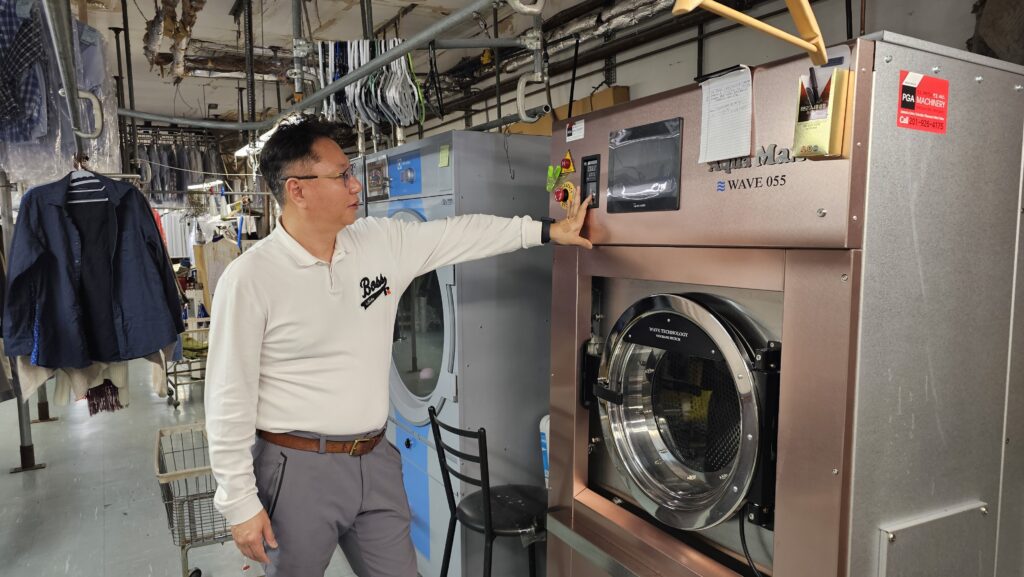
Lee Moo-Hyun, owner of Red Bank Cleaner in Red Bank, New Jersey, experienced firsthand the challenges of converting to 100% wetcleaning. After acquiring a wetcleaning plant in January 2024, he struggled for nearly a year with labor-intensive processes and extended production times.“The most difficult part was having to hang every garment to dry,” Lee explained. “It significantly increased our processing time.”
The turning point came in February 2025 with the installation of the Aquamax system.
“When we pulled a suit jacket out of the dryer, it was practically ready to wear,” he said. “From that point on, the workflow became comparable to drycleaning.”
Lee added that his operation now processes six to ten loads per day, with major production completed by 3 p.m.
“Over the past year, I received a lot of advice and support, but the issues we faced were never fully resolved—until now,” he noted.
Improved Efficiency and Reduced Labor Burden
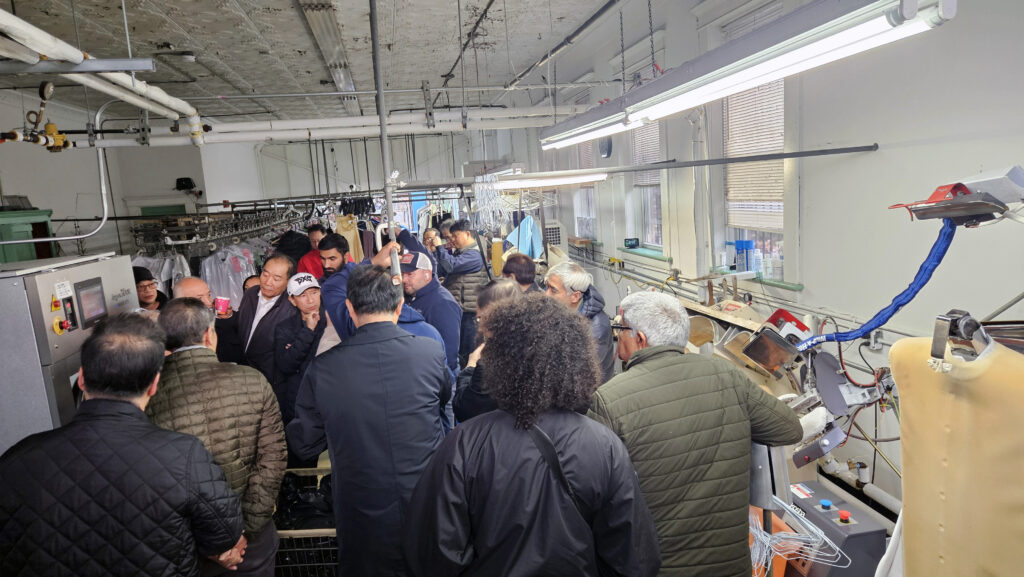
Jang-Geun Cho, owner of Kimber Cleaner in New Jersey and a 10-year wetcleaning veteran, also reports a noticeable shift in workflow.
“In the past, we avoided tumble drying due to concerns about garment damage,” Cho said. “With the Aquamax system, the burden of the drying process has been significantly reduced.”
He estimates that overall operational convenience has improved by approximately 70%, while pressing efficiency has increased by more than 80%.
“Honestly, I was nervous when running the first load,” he recalled. “But the moment I handled the garments coming out of the wash, the texture felt different. That’s when I knew this would work.”
“For the first time in over a decade of wetcleaning, I was able to leave work right at 6 p.m. sharp. Thanks to Aquamax, we’ve even expanded into wholesale services.”
No More Barriers for New Entrants
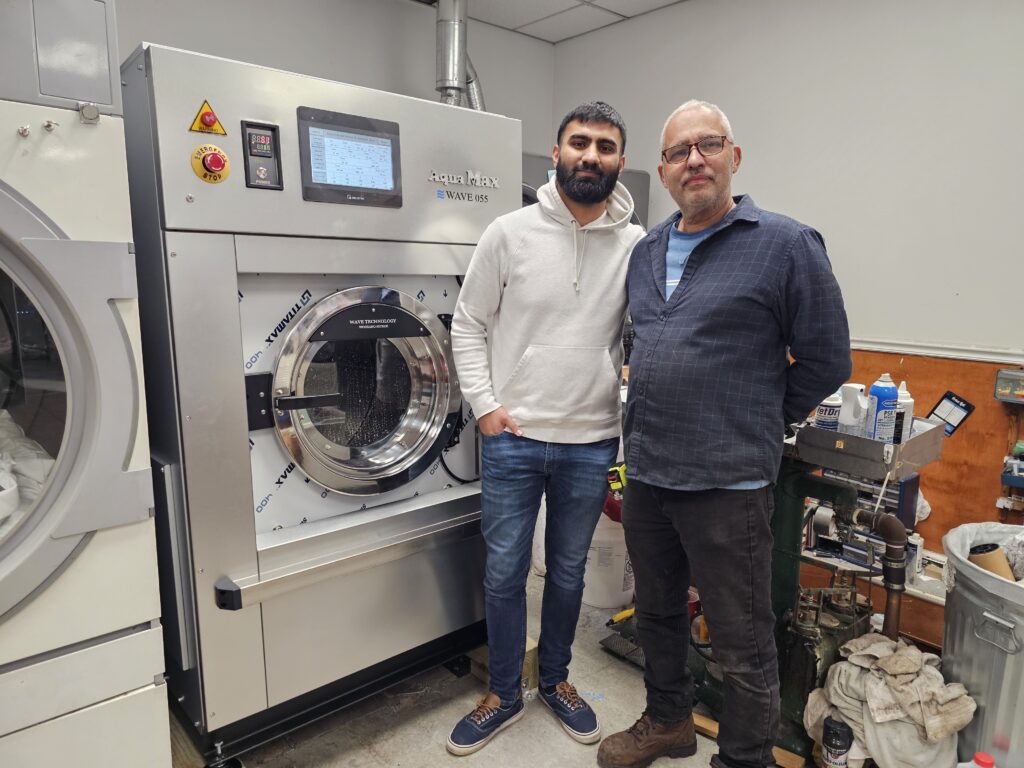
The impact is also evident among new operators. Brothers Hunza Khan and Ahmad Khan, owners of Nami Shirt & Laundry Service in Melville, New York, entered the industry just four months ago with no prior drycleaning experience. Without a drycleaning machine, they had been outsourcing all drycleaning work while handling only laundry in-house.
Their decision to adopt the Aquamax system was driven largely by cost considerations. Monthly outsourcing expenses ranged from $8,000 to $10,000.
“With Aquamax, we’re essentially saving $10,000 a month—it’s like a goose that lays golden eggs,” Khan said.
Since installation, the brothers have been processing a significant portion of their laundry volume through wetcleaning.
“Customers immediately notice the difference in shirt texture and ask what has changed,” he added.
Quality improvements have been particularly notable in garments previously sent out for drycleaning. Dark colors appear deeper and richer, while whites and lighter shades exhibit enhanced brightness—resulting in higher customer satisfaction.
“If beginners like us can perform wetcleaning at the push of a button, it raises the question: do we really need to invest in drycleaning machines that cost three times as much?” Khan remarked.
Standardization on the Horizon?
These developments are prompting industry observers to reconsider the future of wetcleaning. If the process transitions from operator-dependent methods to equipment-driven systems, there is potential for a level of standardization comparable to that of drycleaning.
At the same time, some caution that further validation is needed across a broader range of fabric types and soil conditions. Nevertheless, the tangible changes in day-to-day operations are drawing significant attention.
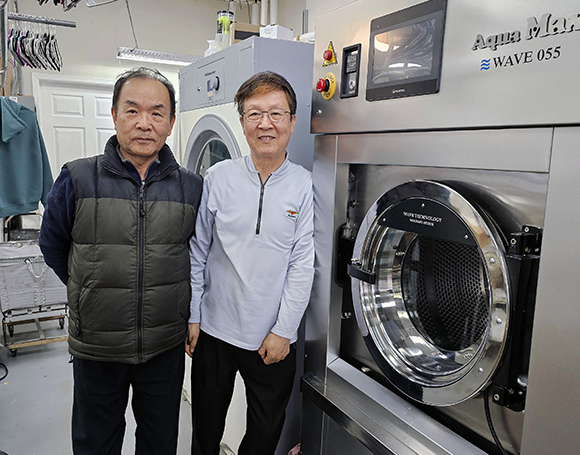
Kim Eui-Seop, president of Ecotech USA, the developer of the Aquamax system, emphasized the company’s vision:
“Wetcleaning has traditionally been a field with significant variation between operators. Our goal is to simplify the process through equipment-driven solutions so that anyone can achieve a consistent level of quality,” he said.
He added that the system is expected to improve processing speed while reducing time spent on spotting and pressing.
“In drycleaning, do we really use the term ‘drycleaning expert’? Anyone can do it by pressing a button. Wetcleaning should be no different,” Kim concluded. “The day may soon come when the term ‘wetcleaning expert’ is no longer needed.”
